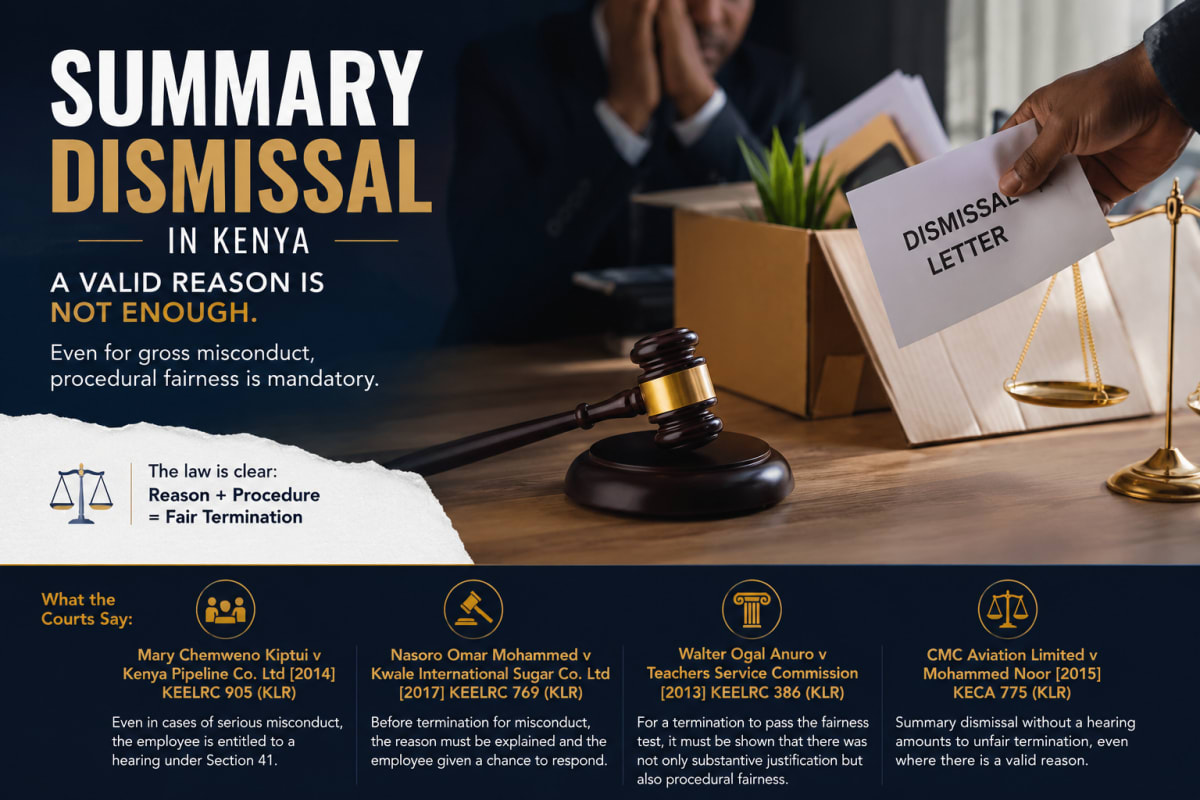
SUMMARY DISMISSAL IN KENYA
A valid reason is never enough
SUMMARY DISMISSAL IN KENYA
"He deserved to be fired anyway!" That argument rarely succeeds in Labour and Employment claims in Kenya. As a matter of fact, Kenyan courts have time and again reasoned to the contrary.
What is summary dismissal?
Summary dismissal can be defined as the termination of employment without notice under Section 44 of the Employment Act, usually for serious misconduct such as absenteeism, insubordination, negligence, and/or dishonesty.
In Walter Ogal Anuro v TSC (2013), the Court was of the opinion that:-
"For a termination to pass the fairness test, it must be shown that there was not only substantive justification for the termination but also procedural fairness."
Likewise, the Court of Appeal in CMC Aviation Ltd v Mohammed Noor (2015), held that an employee facing summary dismissal must still be given an opportunity to be heard.
Accordingly, the principle is simple, even where misconduct is obvious, Section 41 of the Employment Act demands due process. As such, even where an employer who has a good reason but follows a flawed termination process, they may still be found liable for unfair termination.
Under the Kenyan employment law, the lesson remains clear, gross misconduct does not excuse due process, and that a valid reason for dismissal MUST be accompanied by a fair procedure.
What the employer must do before Summary Dismissal?
For procedural fairness, the employer must explain the allegations to the employee in a language they understand, allow the employee time to respond, permit the employee to be accompanied by a fellow employee or union representative, and consider the employee's representations before dismissing the employee summarily.
Find the best Employment & Labour relation Lawyers in Kenya at Musa & Musa Advocates for protection of your rights as an employee.